Transcript Of The Howard Bragman “Where’s My Fifteen Minutes?” Interview

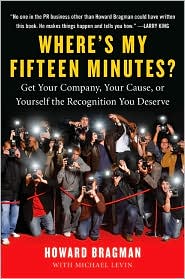

I made a transcript of my interview with Howard Bragman to help me create a post about it. I’m adding it here for anyone who prefers to read the interview instead of downloading and listening to it.
Andrew: Can you tell me about 15 Minutes, your agency?
Howard: Yeah. 15 Minutes is a public relations/media relations PR firm that I founded in 2005. We have about 20 people. We have offices in New York and Los Angeles. We are very eclectic. We represent everything from Broadway shows, to celebrities, to corporations. I do a lot of crisis work. I do what is called media coaching, which helps people get through interviews well.
That’s the second PR firm I founded. The first one is called Bragman Nyman Cafarelli, which is the largest entertainment firm in the world. I founded that 20 years ago in 1989 and then sold it at the end of 2000 and worked for a couple of years and then I retired.
Then I got bored with retirement. I was too young and pretty not to work so I’m back at it and happily so.
Andrew: Can you show off by naming some of the companies and some of the celebrities that you’ve worked with in the past?
Howard: I’m very well known for crisis work. People I’ve worked with in crisis include Ed McMahon and Isaiah Washington and Naomi Campbell and Monica Lewinsky. My last firm has some of the biggest movie stars in the world, people like Cameron Diaz and Kate Hudson and Whoopi Goldberg. My current firm has people like Mario Lopez, Lil’ Kim, Marlee Matlin, Ford Motor Company. I’ve worked with Stevie Wonder. I’ve worked with Katie Couric. I’ve worked with a very eclectic list of people along the way.
Andrew: There’s a perception in my audience that PR is something an entrepreneur does if his business isn’t good enough attract customers on its own or you do if the founder wasn’t hugged enough as a kid. Why should good businesspeople care about PR?
Howard: 10 years ago I kind of think PR was reserved for celebrities. But we live in a different world. We live in the age of YouTube and MySpace and Facebook and Twitter and what’s really changed is we all have a public image. Anybody who’s got any visibility has some sort of public image and the question is – do you want the best public image you can have or do you just want to leave it to chance? Because you’re going to have that image whether you paid attention to it or not.
No one, particularly in this economy, but really in any economy, should leave this to chance. It’s too important. What do any of us own that’s more important than our public image.
Andrew: What do we get if we do PR right? Do we get more customers? Do we get more fanfare?
Howard: You know, your reputation is like a bank account. People are going to give you the benefit of the doubt when things go wrong. People are going to buy more products. People are going to knock on your door. They’re going to respect you more. They’re going to want to hear what you have to say. It’s really not complicated.
Almost anything, any good or service that you’re selling, that’s going to be advanced by having a good image, because everybody knows. We live in cynical times, and everybody knows that advertising is paid for and product placement is paid for. But what they still believe in PR.
It’s what’s called third party endorsement and that has huge value. And, you know, I want to say you can’t buy it but you can buy it if you pay me enough money, hopefully.
Just Google yourself if you’ve never done it and see how much is out there and you’ll go, “Oh wow. I didn’t realize.”
Andrew: And that’s what I wanted to bring you to people because the truth is that today everybody has reporters following them except we don’t call them reporters. We call them friends. We call them bloggers. Friends we went to high school with are posting pictures and stories about us online and everyone else is reporting on us.
Howard: Well, exactly, when you go apply for a job or you go look for a client, don’t think that people aren’t looking at your Facebook page. I had a meeting yesterday and the guys said to me, “I see you’re husband’s a horse trainer, did he pick the Kentucky Derby? You know, people know so much about you that you don’t even think is our there.
Particularly today with the Miss California blowing up. There’s no wall between public and private anywhere. If you end up being a public figure and there are provocative pictures of you out there, they’re going to get out.
Andrew: I talked about bloggers and friend posting pictures online but really I wouldn’t bring someone of your caliber to talk about how to influence what bloggers or friends say…
Howard: The bloggers are important. You may not need me to talk to a blogger but you certainly need to have the same messages and the same strategy for a blogger that you do for New York Times.
Andrew: All right. That’s a good point. I’d like to talk to you about how to get good coverage in both places.
I’ve read your book and I have tons of notes here from Where’s My Fifteen Minutes? and here’s one of the first ones. You say the marketplace will only allow you to have one vision at a time. You used the example in your book of Hillary Clinton running for the senate. Even if in the back of her mind she knew she was going to run for president one day, she had to communicate only the senate vision.
How do we come up with that one vision that we’re going to communicate to the marketplace?
Howard: What you have is a long -term strategic plan and a short-term strategic plan. If you’re Hillary Clinton, your long-term strategic plan is to run for the office of President of the United States. But your short-term plan is to run for senator of the State of New York.
Stick with one vision at a time. I don’t know what it is but we don’t like people to be too uppity. We don’t like people to get too far ahead of themselves. We sort of allow people one dream at a time and once they reach that dream, we’ll let them go to their next dream.
You need to invest some time in that dream and make people believe it. Otherwise what do you get? You get a muddled message. Then if you’re running for senator and you really want to be president the questions that come up are “How are you going to serve the State of New York when you’re really looking to run for president?” Or, “Are you really going to be what’s best for us right now?” Once you are the senator for New York, if you run for president it’s a different kind of situation Constituents start to say, “There’s the honor that our senator is going to be president.” or “Our senator is running for President.”
It’s okay to have big goals and big ambitions but you have to do them in a linear matter. It’s the same thing with companies that do too many things well. You have to sell one thing at a time or at least one thing per marketplace. You can’t sell everything to everybody at the same time.
Andrew: I did an interview with Jason Calacanis who said that statups often tell him what they’ll build next instead of what they have now. I can understand how new company can flub this, but do you have an example of a major company or a major celebrity or somebody who should know better whose message is unfocused?
Howard: I think the Time Warner/AOL merger was a classically bad thing. I don’t think people necessarily understood the messages there. I don’t think they necessarily understood how the synergies were going to work and ultimately they didn’t and it was reflected the financial marketplace and in the consumer marketplace. I think that was a bad thing.
Andrew: I see. Okay. Another message from your book is to spend half your time doing work and the other half telling people what you did. Is that right?
Howard: Well you have to show your credibility and what you are and why you think you deserve to have people come up to you, what it is in your background that made you smart. It doesn’t have to be pure linear but you have to show a record of achievement. You have to show a record of vision and you have to show people you’re capable of handling this.
Andrew: What are some ways to promote properly?
Howard: I think taking each moment and making the best of it. Like everybody else I’m inundated with Facebook updates and Twitters. I want to be honest. There’s a disease out there called “twitterhea.” It’s like diarrhea of the Twitter.
I don’t care that you had sushi for lunch, OK? Be interesting. Be provocative. Be entertaining. Be on message. And something I have to spend time with my own celebrity clients the same way — stop the Twittering that you went to the post office. Nobody really cares. Tell me what’s interesting and different and fun that happened at the post office if you’re a comedian. Or give me some insights. People have to learn when they have a message, it has to stand for something and that’s not to say that you can’t do something without making it public.
People seem to think in this world of Twitter and Facebook updates that if they don’t post it on Facebook or Twitter that it didn’t happen, that it doesn’t have any relevance, which isn’t true. It may be a small moment. It may be collective. But it may be something you want to take a little time to let people know that you do. And that’s basically a judgment call. What is the pace of your life? If you’re given an award or honor it’s nice to let people know you’ve got an award or honor in an appropriate and humble way.
Andrew: How do YOU do that Howard? How do you tell people what you’ve done? How do you communicate your accomplishments?
Howard: I’m pretty lucky. I go on TV a lot. I’m invited on shows like Larry King and Showbiz Tonight and CBS Early Show and I’m one of the go-to guys of crisis PR when somebody gets in trouble.
I think the companies I’ve built, the books I’ve written, the students I’ve taught at the University of Southern California, the clients I’ve represented sort of speak to me. My career did not happen overnight.
I got where I got by thirty plus years of a lot of steps in the same direction. People, younger people seem to be so interested in the quick hit rather than building something for the long haul. I really encourage them to have five and ten year goals as opposed to one month and six month goals where they all think they’re going to build the next great social networking site and sell it to somebody for $200 million. It’s probably not going to happen.
Andrew: I see some of my peers on TV and other media all the time. They’re not the best in the business, but they’re always getting attention. What I want to know is…
Howard: How do you resolve that?
Andrew: Yes.
Howard: How do you resolve that? And the question is this — one of the chapters in my book is how to do an interview. I think there are other good books written on it. There’s whole books on doing interviews and there’s videotapes and you can learn a lot. And I would say I can make almost anybody better. There’s some people who are never going to be great. But most people with enough rehearsal and enough attention can be better and I think it’s like anything else in life. The more you do it, the better you become number one.
Number two, if I’m going on CNN, I don’t walk in the studio and go, “OK what are we talking about?” and answer the questions spur of the moment. I talk to my producer ahead of time and they say, “Here’s what we’re talking about today.” We have a pre-interview. I have three or four messages in my mind that I want to get out. I may have an anecdote or a way I want to get this story out and then I do it. As spontaneous as it may look for some of the better people on TV, it’s rarely spontaneous and that’s sort of the inside secret.
Andrew: So what you’re telling me is that the reason you’re in the media a lot — that you Howard Bragman, I see you on television a lot — is because you give a good interview? And the reason you give a good interview is you pay attention at the pre-interview, go in there with a message and you’re not scripted but you’re planned. Am I hearing you right?
Howard: Absolutely. Absolutely!
And you shouldn’t go on TV unless you have a reason. If you’re going to go on TV, you should say, “I’m going to go on TV because here’s what it’s going to do: it’s going to improve my credibility, it’s going to build my reputation, it’s going to help promote my company.” If it’s not going to do one of those things, walk away from it.
There’s plenty of interviews that I walk away from. As many as I do, there’s probably a bigger number that I choose to walk away from because I don’t think it takes me anywhere or I don’t feel I’m the best expert in that area.
Andrew: OK, so that brings me to another note from your book. You say, “Have a message, a bridge and an anecdote.” Can you explain that to people who are listening to you for the first time and haven’t had a chance to read your book, “Where’s My Fifteen Minutes?”
Howard: It’s shocking that there are people who haven’t read it, first of all.
Andrew: Amazing.
Howard: OK, a message is your core. Those are the three to five points that are going to define who you are and what you’re doing. If I have a message today, it’s that I’m Howard Bragman, a long-time PR person. Number two, that I’ve written this book. Number three that PR is for everyone. Number four that I’ve taken 30 years of my PR career and put it in a way that can help people. Those are your messages, OK?
Andrew: I like that you’re illustrating it using your life and your experiences. Let’s use another example that relates to you. If a crisis happened and they called you, what would your message be in that situation?
Howard: It really depends on the particular person that is under siege. But I will tell you in 95% of the crises, I say “Don’t rush to judgment.” Because usually the first information we get is not the most accurate information. We live in an era of the media where speed trumps accuracy and people are so rushing to get media information out there that they often sacrifice accuracy.
Andrew: If you were to write it down — and I’m sure at this point in your career you don’t have to — is that what you’d write down on your cab ride to CNN studio, “Don’t rush to judgment.” Am I right?
Howard: Yes, exactly. And I DO write things down. I think there’s good transfer that’s going with writing notes and taking things down.
Andrew: OK, the second thing you say is “bridge.” How would the bridge be used when you’re talking in a crisis on television?
Howard: OK, if I was talking about the Chris Brown and Rihanna situation, for example.
Andrew: Chris Brown allegedly hit Rihanna. That hits the news. They say, “We’ve got to get the person to talk about this. Howard Bragman! Rush him into the studio.”
Howard: I talked about it. I said, “I don’t know what happened.” They said, “If Chris Brown did hit Rihanna, how would this affect his career?”
Well, one thing you don’t like to do in interviews is speculate because as soon as you start speculating, the journalists can lead you down the road of “If this happens, what would you do?” You even watch it when you watch politicians on the Sunday morning show. They’ll go, “How would you handle it if…” And most of them say, I don’t want to speculate, but what I can tell you is this…” And they immediately go back to their messages. That’s very important. Your messages are like your safe points.
It’s like if you’re playing a game of baseball. If you’re between the plates, which is the bridge area and is a little more dangerous because you’re going to be tagged out. If you’re on message it’s a much safer place.
Andrew: OK, so the bridge is?
Howard: The bridge is the transition. It’s things like, “That’s not the real issue.” “I would hate to speculate.” That bridge will take you back to your message.
Andrew: Okay, and then the third piece of this is the anecdote.
Howard: And the anecdote is what brings it to life. An anecdote might be, “I had a client who was accused of a sexual impropriety, and here’s how we handled it,” It’s a real life incident that brings some relevance, and brings some other dimensionality to what it is you’re talking about.
Andrew: And you walk into your interviews with your anecdotes, you may have even practiced them at cocktail parties, or practiced them with your friends…
Howard: Well, you know what’s interesting? You should almost have a list of anecdotes, and I’m not a big fan of Ronald Reagan politically, but as a communicator, the guy was a genius. He had a certain number of anecdotes he used in his career, he probably had a hundred anecdotes, and he would use them again and again. But Most people think, “Well, I told that story. I can’t tell that again.” Guess what? You should be so lucky that people get bored of your story. Most people don’t get bored of your stories, because they’re not going to hear them that much. You’re not going to have that much saturation.
Andrew: Okay, let’s talk about “the publicizable moment.” You’re saying that you can’t just get publicity for living and breathing. You’ve got to have these moments that are publicizable, and one of them, I’m assuming, is writing a book. I’m here talking to you because you’ve got a book. Others have had a chance to interview you, because you’ve had a book. It gives you an excuse to ask for interviews, right?
Howard: No…you know what? It really, for me, it’s very funny. Because most people say to me, “Well, you went and wrote this book. Isn’t that going to hurt you from getting clients?” I wrote it because I believe in an empowered electorate. I believe in an empowered, enlightened society. I believe that the more we know about things, the smarter we’re going to be, and the smarter people we’re going to be. And I want to help people. I’ve taught for the better part of a decade at USC, because I want to share my knowledge. I want to share my 30 years. I have something to say…
Andrew: For others, are books publicizable moments?
Howard: A book is not a good way to get rich, okay?
Andrew: No, it’s not.
Howard: But it’s the best calling card you can have.
Andrew: Got you. For you, you don’t need the extra attention. You’re getting on TV before/after, with/without the book. But for others who want to generate publicity for themselves, a good publicizable moment is writing a book, am I right?
Howard: Yeah, but…yes, with a big caveat, and the caveat is, you can sit down and write a blog this afternoon, and post it on your own blog, or someone else’s, and it can be there in a matter of, literally minutes, or hours. If you write a book, it can be a one- or two-year process.
Andrew: I see.
Howard: So, I think before you rush out and write your book, I think you should think about the fact that maybe you want to practice writing some blogs, and getting your voice together first, and getting your reputation together. Frankly, that’s going to help people when you go to sell your book, because there’s three things about selling a book. One is, what is this book about? Two is, why are people going to buy it? And three, why are you the person to write this book? If you don’t have any kind of profile, you’re probably going to have trouble writing the book.
Andrew: Okay, then let me use an example of a publicizable moment that you mentioned in your book: The Moet Index. Moet, the champagne company, decided they needed to have a reason for people to write a story about them. They created an index of luxury goods that included caviar, that included, of course, their champagne, and that gave them a publicizable moment. Every time they refresh the index, which I guess happens annually, reporters have an excuse to write about them, right?
Howard: Exactly.
Andrew: What others are there?
Howard: Putting out a press release, announcing a new product, filing a lawsuit, a hiring, a firing, a financial deal, an opening of a movie, a book or product hitting the market. These are all publicizable moments, and I actually have a very significant list of probably 25 different publicizable moments in the book.
Andrew: Some of the things that you mention in that list happened to me, and happened to everyone in business. I’m going to take one: getting sued. That happens routinely if you’re running a business. It wouldn’t occur to me that it’s a publicizable moment–
Howard: Well, it depends. If you’re the one suing somebody, you may view it as a publicizable moment–your day of justice is coming. If you’re the one getting sued, you either want to defend it aggressively or you want to bury it and you have to decide on a strategy before you decide–if it’s a horse you want to ride if you will. And let me say this, when I say publicizable moment, in most cases they’re proactive. Getting sued is a reactive moment and that’s one of the differences here.
Andrew: What I’d like to know though is once I’ve recognized that I’ve got this publicizable moment, what do I do about it? Who do I call?
Howard: Well hopefully your relationship with the media is something that starts the morning that you have this information to get out. Hopefully, it’s something that you’ve been building, this relationship, along the way. And we think it’s very important that you get media lists, that you define your target audiences, and you do these things ahead of time.
Andrew: So we need to put together a list of people in the media who are reaching our audience in bulk, right?
Howard: Either in bulk or very specific–if you’re doing something in tech, then it may be a blog that reaches ten people, but it may be important.
I’ll tell you something really interesting. I grew up in Flint, Michigan, and there’s a very famous radio station in Detroit called WJR. And they would have people advertise on WJR Radio Station, and it would be like Timken Steele Company would advertise. Guess what? They were reaching about 12 people in the automobile industry. You know what I mean? So it doesn’t have to be a mass audience to be important.
Andrew: Once we find the right people and get their names and contact info, then what? Do we send them an email and start saying “hi”?
Howard: You know, first of all, I like to build relationships ahead of time and if you happen to be in the same city, say, “Hey can we go to lunch? Can we talk? Can I introduce myself?”
I have a client who’s a very important mogul in the entertainment industry and he’s got a book coming out next year, so what are we doing? Well, yesterday we went to lunch with two of the entertainment reporters from the Wall Street Journal. Today, we have a lunch with the editor of Los Angeles Magazine, because I want them to start to think of this guy. I’m planting seeds.
If you say I’ve got an interesting startup company and I’d love to sit down with you, what journalist can tell you “No, I don’t want to learn about an interesting company in the marketplace’?
Yesterday the Journal reporter said, “Oh, I’m doing a story on this that you’d be perfect for, can I call you and ask for a quote?” So I got the end result that I wanted out of it, without being so brazen and up front.
Andrew: What about when they’re not so friendly? What about when they’re treating you as a prey?
Howard: That’s different. That’s when you’re in a crisis situation.
When you’re in a crisis situation you have to take the pulse. I had the right-hand person of a very important client call me about two months ago. Something nasty appeared on a blog and she said, “We’re in full crisis mode!”
I said, “Why?”
She goes, “So-and-so said something nasty on her blog.”
I said, “Honey this isn’t a crisis. This is a blip. This is a Friday afternoon blip on a blog.”
And the bad news and good news of the world we live in is stuff that would ruin careers even a decade ago go by with nary a mention anymore. It’s like, okay she took her clothes off, he did this. This happened, he got a DUI whatever. Next! Go on.
You really have to have some experiences and say, “Am I truly in a crisis mode or is this just a bad day?” And that may be when you want to talk to a PR person.
There are plenty of times when people call me and go, “This just happened. What should I do?”
I had the head of a company call me and one of his employees was on a reality show and came off really badly. I mean he said, “I’ve got a crisis!”
I said, “You don’t really have a crisis.”
We talked it through and in the end he was like, “Oh you’re right. I don’t really have a crisis. Do I? Here’s how to handle it?”
The other thing is, by responding — that’s not to say you should or shouldn’t respond to a specific crisis — but by responding to a crisis you’re throwing fuel on a fire and you’re allowing it to burn hotter and brighter. Do you want it to do that? Do you have to do that? If it’s such a big crisis that it’s not going to go away.
I’m dealing with an agent in the entertainment industry now whose client has just been accused of spousal abuse this weekend. We can’t respond at this time because the lawyer has to lead the charge at this time. If we get too far ahead of the lawyer, the prosecutor is going to get really upset with us. You have to have some knowledge and some experience and make friends with PR people. It’s not going to hurt you.
Let me just give you a little bit of advice here. People say, “How do I find a good PR person?” Well if you happen to be in the tech industry, what are the blogs that you read and you like? Who are the reporters you follow in the New York Times or the Wall Street Journal or Wired or whatever? Talk to these people and say, “Hey. I’m thinking about PR for my company. Who are the PR people you like dealing with the best?”
Two things happen, one you get their insight. You’re going to get the name of somebody they like dealing it. Second they’re likely to say, “Oh, tell me about your company,” and you’ve opened a dialog with that reporter, so two good things happen that way.
Andrew: Let’s close with this. I talk to internet startups that are hoping to build revolutionary companies and that’s why they work night and day. What about you, Howard? What’s the goal for you? What do you want to be remembered by? What are you trying to change in the world?
Howard: People always say, “I want to be creative.” I want to be remembered for WHAT I created. When I look at what I’ve created I think of my employees, my students, the great careers that I’ve built. I think of the companies that I’ve built. I think of the clients that I’ve had the luxury and privilege of working with, helping build their companies. I think of the celebrities I’ve gotten through good times and tough times. I’ve always thought a PR person is a catalyst. We can help be this magic ingredient where one and one can equal three. And if I can do that then I’m very proud to be good at what I do in that way.
Andrew: Well thank you. Thank you for doing this interview. You’re a great teacher. We really went through a bunch of points here and I’m grateful to you for doing that, for teaching us so much.
Howard: Well thank you for having me. Again I encourage people to buy the book. It’s an easy read. If you like Hollywood you’re going to enjoy it. It’s got a lot of information but it’s done very accessibly so don’t be intimidated just because I talk fast.
Andrew: They’ll love the book. They’ll be able to read it just as fast as we both talked on this call. And Howard, check this out, you say business people should build a relationship with a PR person. I just did it right here with you. Good to meet you.
Howard: Am I Facebook friend yet?
Andrew: We’ve got to be friends
Howard: I still have probably 1000 friend spots left on Facebook. You know they give you 5000 and I think I am only about 3700 so I still have some places for people who are listening.