Gary Vaynerchuk wants to know what I think of this video. Here’s my answer.
on Jan 20, 2010 - 11:38 AM PSTThis is part of the behind-the-scenes section of Mixergy, which I call etc.

![]()
I got this Tweet from Gary Vaynerchuk
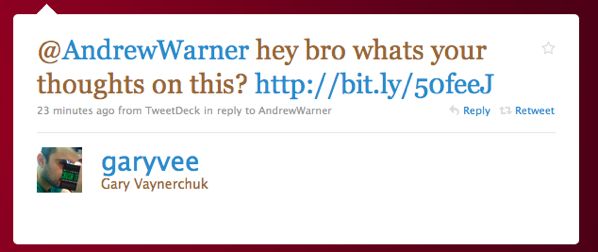
Here’s the part of his video that inspires me
At about a minute into this video he talks about how there’s an expectation that brands and celebrities will respond to people who interact with them.
How this helps you (and me)
Businesspeople with hustle used to spend a lot of time and brainpower cooking up schemes to meet the folks who could kick off their careers.
Roger Enrico, who became the CEO of PepsiCo, used to call his targets late at night, after their secretaries and other gatekeepers went home. George Roberts, who went on to launch the buyout firm KKR, used to find companies he admired, and write their CEOs unsolicited buyout letters. David Geffin, the entertainment mogul, (reportedly) used to secretly read the big-wigs’ mail.
As Gary is pointing out in his video, you don’t have to do that any more. Everyone is accessible via social media. I get CEOs to come to Mixergy with simple Tweets like this. If you have an idea, you can get to know just about anyone online and go into business with them. (This is how one guy did that after listening to a Mixergy interview.)
There’s one place where I disagree with Gary though. I don’t think this is the future. I think for a VERY LIMITED TIME, the top businesspeople will be accessible this way. In a few years, they’ll be overwhelmed by all the interaction and go back to being protected by gatekeepers.
So you better jump on the opportunity while it’s here. (You better believe I am!)
View Comments to “Gary Vaynerchuk wants to know what I think of this video. Here’s my answer.”
Leave a Reply
You must be logged in to post a comment.


January 20th, 2010 at 11:50 am
I'm leaning towards agreement with you on this Andrew. Not sure how long the window will be open but I figure it's going to change after the methodology becomes mainstream.
And I still think getting to meet someone face to face (using methods like you mention) beats the social media approach (if you really want to grow a relationship). What works great today, is combining the two (social and in person), at least in my experience.
January 20th, 2010 at 12:04 pm
Andrew,
Had to weigh in real quick. First this was a great video by Gary, and I think he's dead on with the expectations game. People WILL expect their favorite celebs, business moguls and yes, brands to be engaging on Twitter, FB, etc. And I also agree with you that we're in an attention and networking goldrush. As this builds (and it will) the competition for attention and competition for conversation will start to exist. So I don't think that this sort of interaction can last forever. Gary is a good example of someone who is able to say 'what's up' to a good chunk of his audience, but with every appearance on GMA, every new tasting with Jimmy Fallon, the audience grows and it makes it that much harder to scale those interactions 1:1 (though I wouldn't put it past him to set a goad of continuing to answer every e-mail).
But, I think it all comes down to how bad someone wants a passionate online community. I get really excited any time Gary (or you, or Brogan, etc) responds to a question of mine or a blog I posted, or take the time to have a quick dialogue on Twitter or FB. Right now, its the time that those discussions take that make people feel like part of the community or brand. Maybe down the road there will have to be another mechanism that can scale better, but at a basic level, I think nothing creates a brand evangelist or a fan like a conversation.
January 20th, 2010 at 1:33 pm
I think engaging everyone is a good bootstrapping technique, but I don't see how someone who's on GMA or runs a big company can keep up with it.
January 20th, 2010 at 1:35 pm
I agree. I would love to travel the world and meet as many of my interviewees as possible. Talking to them via Skype and email is helpful, but a single in-person conversation can be more meaningful than dozens of online ones.
Which is why I hope to see you in person again soon too Mike.
January 20th, 2010 at 1:45 pm
Social Media opens up a big opportunity for people who really want to interact with their idols or potential employers, business partners etc. But of course there need to be filters otherwise you would not be able to work anymore.
So if you are interesting or even better if you bring value to those people you now have a bigger chance to get heard.
Brands need to employ fulltime customer relationship manager who scan the social streams to get the buzz and to build up relationships. And also the big ones need to show up from time to time. Today Bill Gates joined Twitter and I am very happy about this fact. The opportunity that he might answer one day one of my tweets is just great.
And about Gary, sure it is harder to get an answer from him like it was before Crush It. But still he tries and that's the point. You need to care and people have to know that you do. Most questions, wishes etc will be asked by a bunch of people so if you address them all at once it's fine, too.
The big change is, as Gary says in this video, we expect that the others are listening. When I say on Twitter “this product is a fail” I already expect an answer of the company.
January 20th, 2010 at 2:57 pm
Good point about the “limited time” factor, Andrew. Sure there are millions of people on Twitter, but I would argue that celebrities and people who are business famous will realize that they can't spend hours a day responding to individuals. It's just impossible to scale. Even brands will need teams of people to handle the inquiries. And after all of that, at some point they will ask the question, “Are we selling more cookies by responding to “Jane” and “Charlie” once a week?” I'm not sure the answer will be yes.
January 21st, 2010 at 8:26 am
Kirsten, you bring up an interesting point of expecting a response for a grievance related to a product or service.
As a customer, Twitter gives you a bigger microphone so people & brands will need to be ultra sensitive to this. The old saying went that “a happy customer will tell 2 people and an unhappy one will 20.” Now an unhappy customer could easily tell 2,000 people. Brands need to be ultra-sensitive to this and act fast to address grievances or else they'll endure lost sales due to the bad reputation.
As someone who is running a company, I find it hard to keep up with the conversations that happen in Twitterverse. I don't know how anyone with more than 1000 'friends' on Twitter can keep up with the stream of tweets that come through.
The only manageable way I've found is by limiting my attention to @replies to me, DMs and searches on specific topics. This seems hypocritical to me as I feel like I'm ignoring everyone, making it pointless to follow anyone. However, that is the only manageable way of using Twitter I've found that lets me actually do some real work.
January 21st, 2010 at 3:26 pm
Kirsten, you bring up an interesting point of expecting a response for a grievance related to a product or service.
As a customer, Twitter gives you a bigger microphone so people & brands will need to be ultra sensitive to this. The old saying went that “a happy customer will tell 2 people and an unhappy one will 20.” Now an unhappy customer could easily tell 2,000 people. Brands need to be ultra-sensitive to this and act fast to address grievances or else they'll endure lost sales due to the bad reputation.
As someone who is running a company, I find it hard to keep up with the conversations that happen in Twitterverse. I don't know how anyone with more than 1000 'friends' on Twitter can keep up with the stream of tweets that come through.
The only manageable way I've found is by limiting my attention to @replies to me, DMs and searches on specific topics. This seems hypocritical to me as I feel like I'm ignoring everyone, making it pointless to follow anyone. However, that is the only manageable way of using Twitter I've found that lets me actually do some real work.